
Austin ISD Draws Its Own Segregation
Austin ISD is under threat of state takeover, and this is driven by the state’s decision to assign failing grades to two deeply economically segregated1 schools for five years in a row under the state’s accountability system. In 2024-25, 92% of Burnet Middle School’s students and 98% of Webb Middle School’s students were economically disadvantaged. More than half the teachers at both schools had five or fewer years of experience.2 The segregation of these schools and others in AISD needs to be a major focus of attention if the district is to set schools up to succeed.
As a result of the repeated failing grades assigned to these schools over years, state law now requires the Texas Education Agency to either:3
a) take over the entire district and appoint a board of managers that will supplant the Austin ISD school board of trustees, or
b) close the two schools that have received five failing grades.
Three other schools — Dobie Middle, Linder Elementary, and Pecan Springs Elementary — are one failing grade away from the same outcome pending testing in spring 2027.4 Six more are at risk because TEA transferred the failing records of closed schools to the campuses that received their students.5 Even if AISD is able to appeal the decision for state takeover or closure of these schools, it could very well face the same choice again next year.
Segregation in schools, both racial and economic, is strongly associated with poor performance.6 High-poverty schools tend to have high turnover and less experienced teachers,7 more challenges due to concentrated poverty (e.g., students moving mid-year, trauma, and higher percentages of English language learners),8 and fewer resources from parent-teacher associations and other school-support nonprofits.9 They also tend to see more students using in-district transfers out of the school, out of the district altogether to charter schools, private schools, and homeschooling that sets off a cycle of continuing concentration of poverty.10
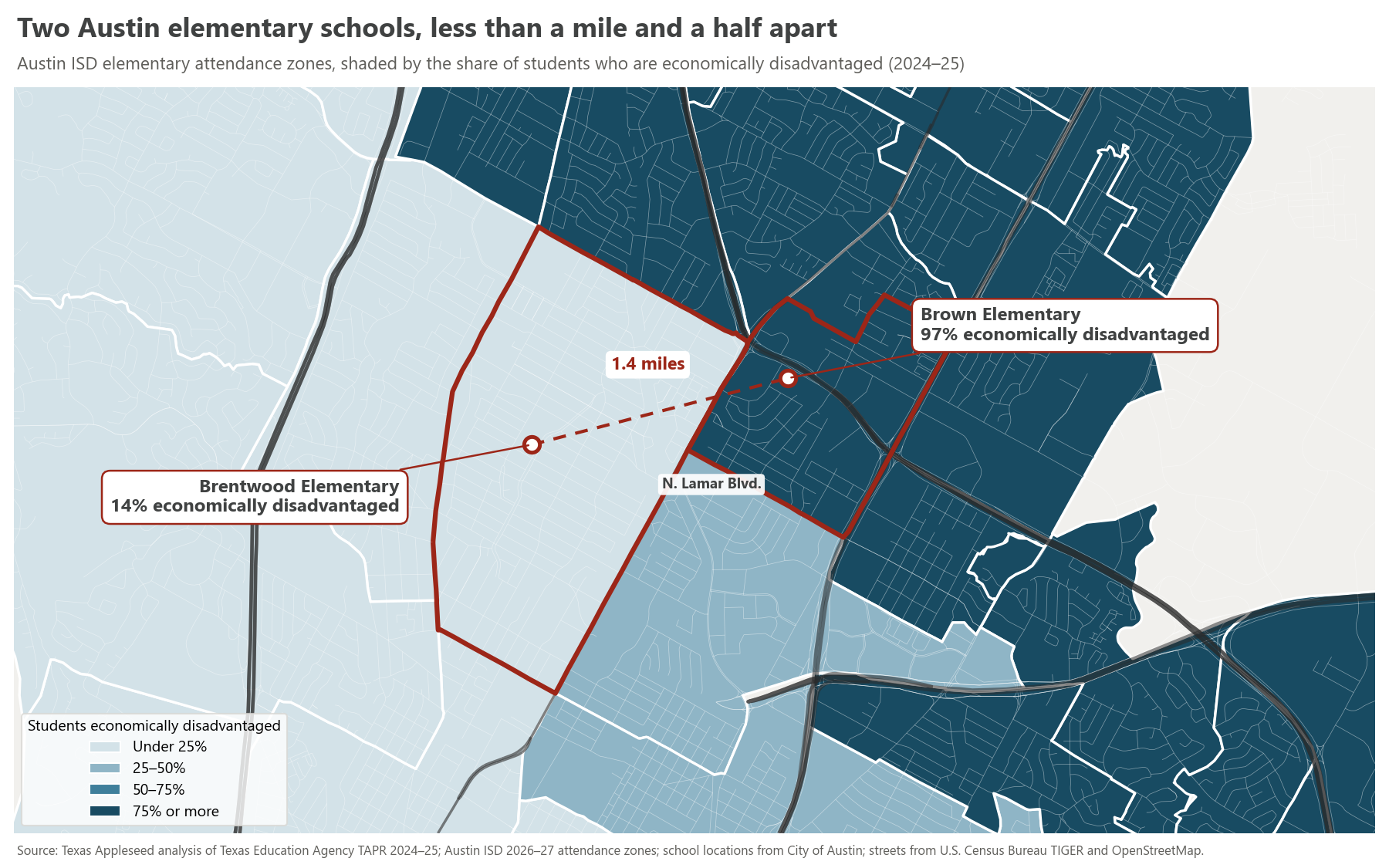
It is notable that unlike many other large urban school districts, Austin’s school segregation is a policy choice. Austin ISD is a truly diverse, mixed-income district: 51.1% of its students are economically disadvantaged, much lower than Dallas ISD at 89.3% or Houston ISD at 77.8%.11 On the map, you can see schools with high levels of economic disadvantage, like Brown Elementary (97% economically disadvantaged), less than a mile and a half from schools with low economic disadvantage, like Brentwood Elementary (14% economically disadvantaged).12
Having two schools nearby with very different student populations is not an isolated occurrence. Texas Appleseed calculated the district’s dissimilarity index, a standard measure of segregation: the share of economically disadvantaged students who would have to change schools for every campus to match the district-wide mix. We found a score of 60.6 across all campuses, right at the threshold researchers conventionally use for high segregation, and elementary schools had a DI of 63.8 among elementary schools, clearly in the high segregation category.13 That is much higher than peer districts with similar demographics and size, like Northside ISD (DI of 38.9, economic disadvantage of 50%) and Fort Bend ISD (DI of 40.2, economic disadvantage of 47.5%).14
It is not just about the schools flagged by TEA for regularly receiving failing grades. Many of AISD’s schools that perform poorly on state accountability ratings are especially segregated. Sixty-five percent of schools with economic disadvantage of 75% or more received TEA ratings of D or F, while every single school with less than 25% economic disadvantage scored an A or B.15 While scholars widely acknowledge that state-created accountability ratings that rely heavily on standardized tests are a flawed measure of school quality,16 the same patterns can be found in other data. Middle and high schools where more than 75% of students were economically disadvantaged suspended students out of school at five times the rate of those where 25% or fewer were (9.3% versus 1.8% of students in 2024-25).17 Middle and high schools with high economic disadvantage had twice the share of first-year teachers of low-disadvantage schools (12.3% versus 5.9%), and even high-disadvantage elementary schools had 1.5 times the share (12.1% versus 8.1%).18
More diverse schools bring a wide variety of benefits. For instance, economically diverse schools can improve economic connectedness (friendship groups where there are a mix of high and low socioeconomic statuses), which is a strong predictor of upward economic mobility according to research from Raj Chetty, et al.19 Economic connectedness can increase access to information, mentorship, and job opportunities. Austin ISD’s high schools showed markedly high rates of sorting compared to other school districts. This reduces the opportunities for students to make those connections in one of the major times of life where they can be made.20 It is also clear that just physically integrating campuses is not enough. The same Chetty study cited above also found that most of the gains in economic mobility come from schools that are both integrated and have a low “friending bias,” a term for when students tend to make friends mostly with others who are like themselves. A real plan for integration has to address how to connect students from different backgrounds and encourage a diverse student body to form a true community school.21
AISD has been considering a wholesale redrawing of its attendance zones and a rewrite of its transfer policies since spring 2025.22 The process was delayed to focus on school closures, and then delayed again this year.23 Right now, the proposal is to bring this redrawing of attendance zones up in 2027.24 AISD has not systematically revisited its school attendance zones in decades.25 Unfortunately, instead of using the opportunity of redrawing attendance zones to address segregation on its campuses, the district has focused on aligning feeder patterns and making sure every campus has a healthy-sized student population.26
While these criteria are important, not including measurements of school segregation in the process is a missed opportunity. The neighborhoods from which students are drawn are not as segregated by income as the schools are, and significant gains could be made just by redrawing the lines on the map, without extra busing or transportation needed. As it makes decisions about AISD attendance zones next year, the school board should include a real plan to integrate AISD schools more fully as a strategy to improve student outcomes.
Disclosure: Much of the analysis for this piece was conducted with the aid of Claude Code, a large language model from Anthropic. All original writing was by the author, and data analysis was confirmed by the author by reviewing formulae and checking that data was imported correctly.
1 Recent court decisions call into question whether Austin ISD can take into account racial segregation in its official actions. Therefore, this blog post primarily looks through the lens of economic segregation. Texas Appleseed’s mission is to promote social, economic, and racial justice, and we believe that racial segregation in AISD is an important topic worthy of further exploration.
2 Texas Appleseed analysis of teacher experience data from: Texas Education Agency, 2025a.
3 Tex. Educ. Code § 39A.111 (2021). https://tcss.legis.texas.gov/resources/ED/htm/ED.39A.htm
AISD has challenged both ratings; under this section the commissioner makes the final decision: Tex. Educ. Code § 39.151 (2025). https://tcss.legis.texas.gov/resources/ED/htm/ED.39.htm
McLaren, J. (2026, September 18). Austin ISD appeals failing school ratings for Burnet, Webb. Community Impact. https://communityimpact.com/central-austin/education/austin-isd-appeals-failing-school-ratings-for-burnet-webb/
4 Counts of four unacceptable ratings: Texas Education Agency, 2026b.
Why Dobie’s 2026 D holds its count rather than resetting it: Tex. Educ. Code § 39A.118 (2021). https://tcss.legis.texas.gov/resources/ED/htm/ED.39A.htm
5 Coronado, A. (2026, September 21). Austin ISD faces new state intervention risk with nine schools this school year. Austin Current. https://austincurrent.org/2026/09/21/austin-austinisd-takeover-school-ratings-paredes-bailey/
The closed schools’ counts of four appear in: Texas Education Agency, 2026b.
6 In national data on high school students from the 2000s, racial/ethnic and socioeconomic segregation are strongly associated with academic performance: Palardy, G. J., Rumberger, R. W., & Butler, T. (2015). The effect of high school socioeconomic, racial, and linguistic segregation on academic performance and school behaviors. Teachers College Record, 117(12), 1–52. https://doi.org/10.1177/016146811511701206
A research review concluding that attending racially segregated, high-poverty schools “has a strong negative association with students’ academic achievement”: Wells, A. S., Fox, L., & Cordova-Cobo, D. (2016, February 9). How racially diverse schools and classrooms can benefit all students. The Century Foundation. https://tcf.org/content/report/how-racially-diverse-schools-and-classrooms-can-benefit-all-students/
7 Teachers are more likely to leave schools serving low-income, minority and low-achieving schools: Hanushek, E. A., Kain, J. F., & Rivkin, S. G. (2004b). Why public schools lose teachers. The Journal of Human Resources, 39(2), 326–354. https://doi.org/10.2307/3559017
8 On student mobility, which harms movers and their classmates and is concentrated in lower-income schools: Hanushek, E. A., Kain, J. F., & Rivkin, S. G. (2004a). Disruption versus Tiebout improvement: The costs and benefits of switching schools. Journal of Public Economics, 88(9–10), 1721–1746.
9 Nonprofit contributions flow disproportionately to wealthier districts (district-level data): Nelson, A. A., & Gazley, B. (2014). The rise of school-supporting nonprofits. Education Finance and Policy, 9(4), 541–566. https://doi.org/10.1162/EDFP_a_00146
10 Exit to private schools from schools with concentrated poverty: Fairlie, R. W., & Resch, A. M. (2002). Is there “white flight” into private schools? Evidence from the National Educational Longitudinal Survey. The Review of Economics and Statistics, 84(1), 21–33.
Exit through in-district school choice: Saporito, S. (2003). Private choices, public consequences: Magnet school choice and segregation by race and poverty. Social Problems, 50(2), 181–203.
Withdrawal to private, charter and magnet schools leaves neighborhood schools poorer than their zones: Saporito, S., & Sohoni, D. (2007). Mapping educational inequality: Concentrations of poverty among poor and minority students in public schools. Social Forces, 85(3), 1227–1253.
11 Texas Education Agency, 2025a.
12 Percentages: Texas Education Agency, 2025a.
13 Massey and Denton classify values of 0-30 as low, 31-60 as moderate and 61-100 as high segregation (p. 20): Massey, D. S., & Denton, N. A. (1993). American apartheid: Segregation and the making of the underclass. Harvard University Press.
14 Texas Appleseed analysis of campus-level data from: Texas Education Agency, 2025a.
15 Texas Appleseed analysis of 2025 campus ratings and 2024-25 campus data from: Texas Education Agency, 2025a.
Texas Education Agency. (2025b). 2025 accountability ratings: Data download [Data set]. https://rptsvr1.tea.texas.gov/perfreport/account/acct_download?year=2025
16 See, e.g., Noonan, J. & Piazza, P. (2023). Accountability Systems and the Persistence of School Segregation: Research Evidence and Future Directions. The National Coalition on School Diversity. https://files.eric.ed.gov/fulltext/ED627089.pdf.
17 Texas Appleseed analysis of: Texas Education Agency. (2025c). Campus level annual discipline summary, 2024–2025 [Data set]. https://rptsvr1.tea.texas.gov/adhocrpt/Disciplinary_Data_Products/Discipline_Summary_Download.html
18 Texas Appleseed analysis of teacher experience data from: Texas Education Agency, 2025a.
19 Chetty, R., Jackson, M. O., Kuchler, T., Stroebel, J., Hendren, N., Fluegge, R. B., Gong, S., Gonzalez, F., Grondin, A., Jacob, M., Johnston, D., Koenen, M., Laguna-Muggenburg, E., Mudekereza, F., Rutter, T., Thor, N., Townsend, W., Zhang, R., Bailey, M., . . . Wernerfelt, N. (2022a). Social capital I: Measurement and associations with economic mobility. Nature, 608(7921), 108-121. https://doi.org/10.1038/s41586-022-04996-4
20 Texas Appleseed analysis of high school data from the Social Capital Atlas, matched to TEA campuses. Of 15 urban Texas districts, AISD had the widest spread across its high schools in how many higher-income schoolmates low-income students had. The data describe people aged 25-44 in 2022, roughly the high school classes of 1996-2015: Data for Good at Meta, 2022.
About half the class gap in economic connectedness comes from differences in exposure to higher-income people in settings such as high schools: Chetty et al., 2022b.
21 See for example Integrate NYC’s 5 Rs of Integration (Integrate NYC, n.d.), and Texas Appleseed’s report on Beaumont ISD (Texas Appleseed, 2024).
22 Austin Independent School District. (n.d.). Austin ISD boundary realignment process. Retrieved September 23, 2026, from https://www.austinisd.org/boundaries
Proposed transfer policy changes: Austin Independent School District. (2025, October 31). Austin ISD recommended school consolidation and boundary change plan. https://www.austinisd.org/sites/default/files/dept/consolidation/docs/drafts/AustinISD_Consolidation_And_Boundary_Change_Plan_Oct3_Eng.pdf
23 Districtwide rezoning delayed in November 2025 while 10 closures went ahead: McAfee, K., & Davis, W. (2025, November 4). AISD removes three schools from closures list, delays districtwide rezoning. KUT. https://www.kut.org/education/2025-11-04/austin-tx-aisd-school-closures-plan-budget,
Austin ISD postpones districtwide boundary changes, says more school closures are possible. Austin Current. https://austincurrent.org/2026/06/29/austin-isd-boundary-changes-school-closures/
24 Austin Independent School District. (2026, July 3). An update on the boundary process. https://www.austinisd.org/announcements/2026/07/03/update-boundary-process-en-espanol
25 The last documented districtwide change to how students were assigned to schools was the end of elementary busing in 1987: McInerny, C. (2019, August 14). Austin failed at desegregation before. That history influences today’s school closure decisions. KUT. https://www.kut.org/education/2019-08-14/austin-failed-at-desegregation-before-that-history-influences-todays-school-closure-decisions
26 Austin Independent School District, n.d.
References
Austin Independent School District. (n.d.). Austin ISD boundary realignment process. Retrieved September 23, 2026, from
https://www.austinisd.org/boundaries
Austin Independent School District. (2025, October 31). Austin ISD recommended school consolidation and boundary change plan.
https://www.austinisd.org/sites/default/files/dept/consolidation/docs/drafts/AustinISD_Consolidation_And_Boundary_Change_Plan_Oct3_Eng.pdf
Austin Independent School District. (2026, July 3). An update on the boundary process.
https://www.austinisd.org/announcements/2026/07/03/update-boundary-process-en-espanol
Carbonaro, W., Lauen, D. L., & Levy, B. L. (2023). Does cumulative exposure to high-poverty schools widen test-score inequality?
Sociology of Education, 96(2), 81–103. https://doi.org/10.1177/00380407221147889
Chetty, R., Jackson, M. O., Kuchler, T., Stroebel, J., Hendren, N., Fluegge, R. B., Gong, S., Gonzalez, F., Grondin, A., Jacob, M.,
Johnston, D., Koenen, M., Laguna-Muggenburg, E., Mudekereza, F., Rutter, T., Thor, N., Townsend, W., Zhang, R., Bailey, M., . . . Wernerfelt, N. (2022a). Social capital I: Measurement and associations with economic mobility. Nature, 608(7921), 108–121. https://doi.org/10.1038/s41586-022-04996-4
Chetty, R., Jackson, M. O., Kuchler, T., Stroebel, J., Hendren, N., Fluegge, R. B., Gong, S., Gonzalez, F., Grondin, A., Jacob, M.,
Johnston, D., Koenen, M., Laguna-Muggenburg, E., Mudekereza, F., Rutter, T., Thor, N., Townsend, W., Zhang, R., Bailey, M., . . . Wernerfelt, N. (2022b). Social capital II: Determinants of economic connectedness. Nature, 608(7921), 122–134. https://doi.org/10.1038/s41586-022-04997-3
City of Austin. (n.d.). Schools and school boundaries [Data set]. Retrieved September 23, 2026, from
https://services.arcgis.com/0L95CJ0VTaxqcmED/arcgis/rest/services/Schools_and_School_Boundaries/FeatureServer/0
Coronado, A. (2026, September 21). Texas transfers failing ratings to six AISD schools. Austin Current.
https://austincurrent.org/2026/09/21/austin-austinisd-takeover-school-ratings-paredes-bailey/
Data for Good at Meta. (2022). Social Capital Atlas: US high schools [Data set]. Humanitarian Data Exchange. https://data.humd
ta.org/dataset/social-capital-atlas
Fairlie, R. W., & Resch, A. M. (2002). Is there “white flight” into private schools? Evidence from the National Educational Longitudinal
Survey. The Review of Economics and Statistics, 84(1), 21–33.
Hanushek, E. A., Kain, J. F., & Rivkin, S. G. (2004a). Disruption versus Tiebout improvement: The costs and benefits of switching
schools. Journal of Public Economics, 88(9–10), 1721–1746.
Hanushek, E. A., Kain, J. F., & Rivkin, S. G. (2004b). Why public schools lose teachers. The Journal of Human Resources, 39(2),
326–354. https://doi.org/10.2307/3559017
IntegrateNYC. (n.d.). The policy platform for school integration. Retrieved October 12, 2026, from https://integratenyc.org/platform
KUT News. (2026, June 29). Austin ISD postpones districtwide boundary changes, says more school closures are possible. Austin
Current. https://austincurrent.org/2026/06/29/austin-isd-boundary-changes-school-closures/
Massey, D. S., & Denton, N. A. (1993). American apartheid: Segregation and the making of the underclass. Harvard University
Press.
McAfee, K., & Davis, W. (2025, November 4). AISD removes three schools from closures list, delays districtwide rezoning. KUT.
https://www.kut.org/education/2025-11-04/austin-tx-aisd-school-closures-plan-budget
McInerny, C. (2019, August 14). Austin failed at desegregation before. That history influences today’s school closure decisions. KUT.
https://www.kut.org/education/2019-08-14/austin-failed-at-desegregation-before-that-history-influences-todays-school-closure-decisions
McLaren, J. (2026, September 18). Austin ISD appeals failing school ratings for Burnet, Webb. Community Impact. https://commun
tyimpact.com/central-austin/education/austin-isd-appeals-failing-school-ratings-for-burnet-webb/
Nelson, A. A., & Gazley, B. (2014). The rise of school-supporting nonprofits. Education Finance and Policy, 9(4), 541–566.
https://doi.org/10.1162/EDFP_a_00146
Palardy, G. J., Rumberger, R. W., & Butler, T. (2015). The effect of high school socioeconomic, racial, and linguistic segregation on
academic performance and school behaviors. Teachers College Record, 117(12), 1–52. https://doi.org/10.1177/016146811511701206
Saporito, S. (2003). Private choices, public consequences: Magnet school choice and segregation by race and poverty. Social
Problems, 50(2), 181–203.
Saporito, S., & Sohoni, D. (2007). Mapping educational inequality: Concentrations of poverty among poor and minority students in
public schools. Social Forces, 85(3), 1227–1253.
Texas Appleseed. (2024). Segregation's impact and the pursuit of school integration: Insights from Beaumont,
Texas. https://www.texasappleseed.org/sites/default/files/2024-11/integration-segregation_report_web_11-12-24.pdf
Tex. Educ. Code § 39.151 (2025). https://tcss.legis.texas.gov/resources/ED/htm/ED.39.htm
Tex. Educ. Code § 39A.111 (2021). https://tcss.legis.texas.gov/resources/ED/htm/ED.39A.htm
Tex. Educ. Code § 39A.118 (2021). https://tcss.legis.texas.gov/resources/ED/htm/ED.39A.htm
Texas Education Agency. (2025a). 2024–25 Texas Academic Performance Reports: Data download [Data set]. https://rptsvr1.tea
texas.gov/perfreport/tapr/tapr_dd_download.html?year=2025
Texas Education Agency. (2025b). 2025 accountability ratings: Data download [Data set]. https://rptsvr1.tea.texas.gov/perfreport/a
count/acct_download?year=2025
Texas Education Agency. (2025c). Campus level annual discipline summary, 2024–2025 [Data set].
https://rptsvr1.tea.texas.gov/adhocrpt/Disciplinary_Data_Products/Discipline_Summary_Download.html
Texas Education Agency. (2026a). 2026 accountability ratings: Data download [Data set]. https://rptsvr1.tea.texas.gov/perfreport/a
count/acct_download?year=2026
Texas Education Agency. (2026b). 2026 consecutive unacceptable list [Data set]. https://tea.texas.gov/school-and-district-leaders/a
countability/academic-accountability/performance-reporting/2026-consecutive-unacceptable-list.xlsx
Wells, A. S., Fox, L., & Cordova-Cobo, D. (2016, February 9). How racially diverse schools and classrooms can benefit all students.
The Century Foundation. https://tcf.org/content/report/how-racially-diverse-schools-and-classrooms-can-benefit-all-students/